GDPR-Compliant Server-Side Tracking: A Practical Implementation Guide [2026]
Learn how to implement server-side tracking that is fully GDPR and CCPA compliant. Covers consent-gated pipelines, data minimization, and privacy-first signal architecture.
![Featured image for GDPR-Compliant Server-Side Tracking: A Practical Implementation Guide [2026]](/blog/gdpr-compliant-server-side-tracking/hero.png)
Direct Answer: GDPR-compliant server-side tracking requires enforcing consent at the infrastructure level, not just in the consent banner. You need a consent-gated signal pipeline where each event is tagged with the user’s consent tier, a first-party gateway that strips or retains fields based on that tier before dispatch, and an audit trail that records what was sent, to whom, and under what legal basis. Done correctly, server-side tracking does not conflict with GDPR — it becomes the most reliable way to achieve both privacy compliance and signal accuracy.
Moving tracking server-side is not a privacy workaround. It is a structural advantage. When your gateway sits between the browser and every downstream destination, you gain a single enforcement point for consent policy, data minimization, and purpose limitation. But this advantage only materializes if you design the pipeline correctly from the start.
This guide covers how to build a privacy-compliant server-side tracking pipeline — from consent collection through gateway enforcement to auditable delivery. It is technical guidance for operators, not legal advice. Consult your Data Protection Officer or legal counsel for binding compliance decisions.
Table of Contents
- Why Server-Side Tracking Is Not a Privacy Workaround
- The Consent-First Signal Pipeline
- GDPR Requirements That Apply to Server-Side Tracking
- CCPA and US State Privacy Considerations
- Consent Collection Done Right
- Gateway-Level Policy Enforcement
- Logging, Audit Trail, and Accountability
- Implementation Checklist
- Common Compliance Mistakes in Server-Side Setups
- FAQ
Why Server-Side Tracking Is Not a Privacy Workaround
There is a persistent misconception that server-side tracking exists to bypass privacy controls. In reality, the opposite is true — when implemented correctly, server-side tracking gives you more privacy control than client-side tracking ever could.
The client-side problem
With traditional JavaScript-based tracking, here is what happens:
User clicks "Buy Now"
  → Browser fires Meta Pixel
  → Browser fires Google Tag
  → Browser fires TikTok Pixel
  → Browser fires analytics tag
  → Each tag sends whatever data it can access
  → No centralized control over what gets sent
Every tag running in the browser has access to the full page context: URL, cookies, referrer, user agent, and anything in the DOM. Even with a consent banner, client-side enforcement is fragile. A misconfigured tag manager or a third-party script can leak data before consent logic executes.
The server-side advantage
When you move tracking to a server-side architecture, the data path changes fundamentally:
User clicks "Buy Now"
  → Browser sends event to YOUR first-party endpoint
  → Your gateway checks consent tier
  → Gateway strips fields not covered by consent
  → Gateway forwards filtered payload to each destination
  → Gateway logs what was sent, to whom, and why
The browser never talks directly to third-party ad platforms. Your gateway becomes the single enforcement point for consent policy. This is not a workaround — it is data protection by design, exactly what GDPR Article 25 calls for.
What regulators actually care about
Regulators do not care whether your tracking is client-side or server-side. They care about:
- Is there a lawful basis for processing?
- Does the data subject have meaningful control?
- Is data collection proportionate to the stated purpose?
- Can you demonstrate what you collected and why?
Server-side tracking does not automatically satisfy these requirements. But it gives you the architectural tools to satisfy them in a way that client-side tracking cannot match.
The Consent-First Signal Pipeline
A privacy-compliant server-side tracking implementation is organized around consent tiers — graduated levels of data collection and processing that map directly to what the user has agreed to.
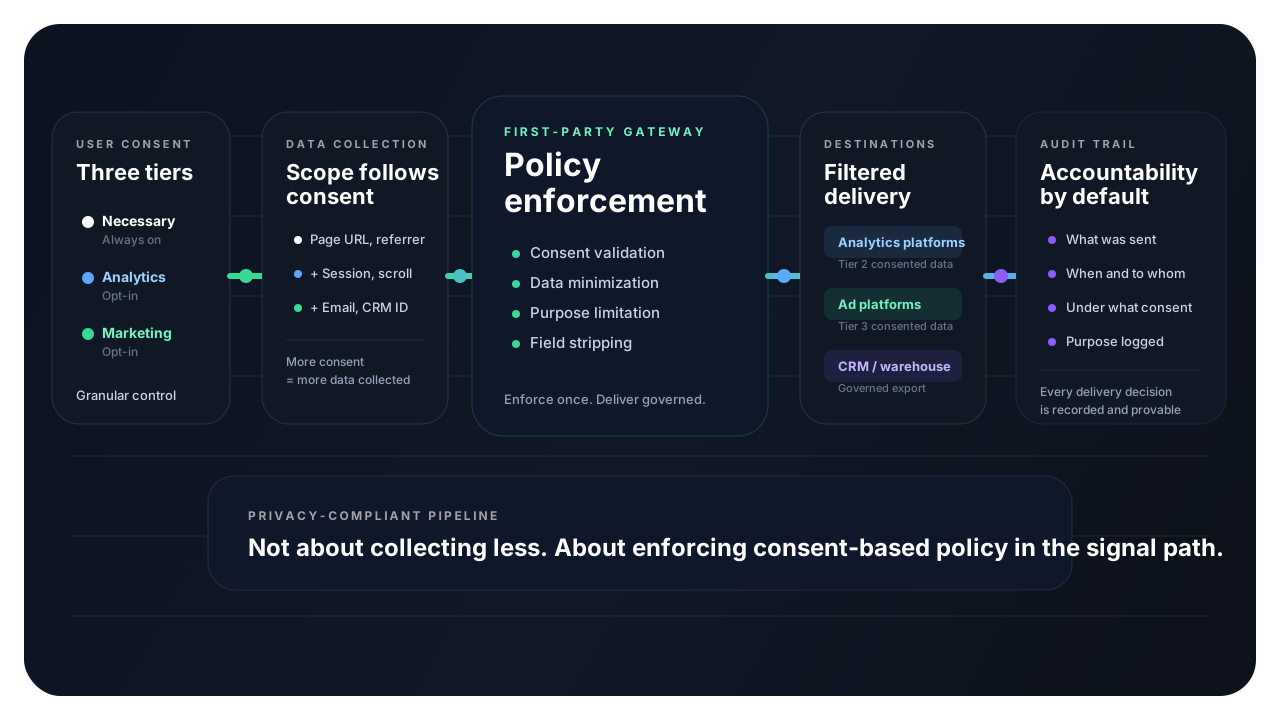
Privacy-compliant server-side tracking is not about collecting less. It is about enforcing consent-based policy in the signal path so every delivery decision is governed and auditable.
Consent Tier 1: Necessary (always on)
This tier covers processing that is strictly necessary for the service to function. Under GDPR, this does not require consent — it falls under the legitimate interest or contractual necessity basis.
Data collected at Tier 1:
- Page URL and referrer (for navigation)
- Session identifier (first-party, short-lived)
- Basic error telemetry
- Cart state for e-commerce transactions
What this does NOT include: User profiling, cross-session tracking, advertising identifiers, or behavioral analytics.
Consent Tier 2: Analytics (opt-in required)
Analytics consent covers measurement and performance optimization. The user has agreed that you can track how they use your site beyond what is strictly necessary.
Additional data collected at Tier 2:
- Scroll depth, time on page
- Navigation paths and funnel progression
- Device type, viewport, connection quality
- Aggregated conversion events
Consent Tier 3: Marketing (opt-in required)
Marketing consent permits data processing for advertising purposes, including retargeting, lookalike audience building, and cross-platform attribution.
Additional data collected at Tier 3:
- Hashed email address (SHA-256)
- Hashed phone number
- External click identifiers (fbclid, gclid, ttclid)
- Customer lifetime value signals
- Product interest and purchase behavior
How the tiers map to destination delivery
This is where the gateway does its work. Not every destination receives the same data:
| Destination | Required Consent Tier | Data Received |
|---|---|---|
| Error monitoring | Tier 1 (Necessary) | Page URL, error details, session ID |
| First-party analytics | Tier 2 (Analytics) | Page views, funnels, scroll depth, device |
| Google Analytics 4 | Tier 2 (Analytics) | Events, user properties, session data |
| Meta Conversions API | Tier 3 (Marketing) | Hashed PII, event data, click IDs |
| Google Ads Enhanced Conversions | Tier 3 (Marketing) | Hashed email, conversion value |
| TikTok Events API | Tier 3 (Marketing) | Hashed PII, event data, click IDs |
The gateway checks each outbound delivery against the user’s recorded consent tier. If a user has only granted analytics consent, their data reaches GA4 but never reaches Meta CAPI or ad platforms. The gateway enforces this at the infrastructure level. No tag manager configuration or client-side logic is involved.
GDPR Requirements That Apply to Server-Side Tracking
Moving tracking to server-side does not exempt you from GDPR. Every core principle still applies. Here is how each one maps to a server-side implementation.
Lawful basis for processing (Article 6)
You need a valid legal basis for every processing activity. For server-side tracking, the most common bases are:
- Consent (Art. 6(1)(a)): Required for analytics and marketing tracking. Must be freely given, specific, informed, and unambiguous.
- Legitimate interest (Art. 6(1)(f)): May cover essential operational analytics (like error monitoring), but requires a documented Legitimate Interest Assessment (LIA).
- Contractual necessity (Art. 6(1)(b)): Covers processing needed to fulfill a purchase — e.g., transaction logging for order confirmation.
Practical rule: If the data processing serves your business intelligence or advertising goals rather than the user’s direct need, you need consent.
Data minimization (Article 5(1)(c))
You must collect only the data that is adequate, relevant, and necessary for each stated purpose. Server-side tracking makes this enforceable:
- At collection: Only capture fields appropriate for the granted consent tier
- At the gateway: Strip fields that are not needed for a specific destination
- At dispatch: Send each destination only the fields it actually requires
For example, Meta CAPI needs hashed email, event name, and event value. It does not need scroll depth, time on page, or navigation history. Your gateway should strip these before dispatch.
Purpose limitation (Article 5(1)(b))
Data collected for analytics cannot be repurposed for marketing without additional consent. In a server-side setup, this means:
- Tag each event with its consent tier and declared purpose at collection time
- At the gateway, validate that each destination’s purpose matches the consented purpose
- Do not merge analytics-consented data into marketing audience pipelines
Storage limitation (Article 5(1)(e))
Personal data must not be kept longer than necessary. This applies to:
- Event logs: Retain raw event data only for the period needed for analytics processing, then aggregate or delete
- Hashed PII: Even hashed data is personal data under GDPR — apply retention limits
- Gateway logs: Keep delivery audit logs for accountability, but strip PII from logs after a defined period
Right to erasure (Article 17)
If a user requests deletion under the “right to be forgotten,” you must be able to:
- Identify all data associated with that user across your tracking pipeline
- Delete or anonymize it within a reasonable timeframe
- Confirm deletion to the user
Server-side tracking helps here because all data passes through your gateway — you have a centralized index of what was collected and where it was sent. With client-side tracking, data scattered across dozens of third-party platforms makes erasure nearly impossible to verify.
Data protection by design (Article 25)
This is where server-side tracking truly shines. GDPR Article 25 requires that data protection be built into processing systems from the start, not bolted on afterward.
A properly designed server-side pipeline is Article 25 in action:
- Consent is checked before data enters the processing pipeline
- Minimization is enforced at the gateway, not in a tag manager
- Purpose limitation is built into the routing logic, not a policy document
- Audit trails are generated automatically, not assembled after the fact
CCPA and US State Privacy Considerations
While GDPR is consent-first, US privacy laws follow an opt-out model. Your server-side pipeline needs to handle both paradigms.
Do Not Sell / Do Not Share (CCPA/CPRA)
Under CCPA, “selling” data includes sharing personal information with ad platforms for cross-context behavioral advertising — even if no money changes hands. When a user opts out:
- Your gateway must stop sending identifiers (hashed email, phone) to ad platforms
- Contextual, non-personal event data (page view, product category) may still be sent
- The opt-out must be respected across all downstream destinations
Global Privacy Control (GPC)
The Global Privacy Control signal is a browser-level opt-out that CCPA requires businesses to honor. Your server-side pipeline should:
- Detect the
Sec-GPC: 1header on inbound requests - Treat it as an opt-out of sale/sharing
- Downgrade the consent tier to exclude marketing destinations
- Log that GPC was detected and honored
Multi-state compliance matrix
| Requirement | GDPR (EU) | CCPA/CPRA (CA) | CPA (CO) | VCDPA (VA) | TDPSA (TX) |
|---|---|---|---|---|---|
| Consent model | Opt-in | Opt-out | Opt-out | Opt-out | Opt-out |
| Consent for analytics | Required | Not required | Not required | Not required | Not required |
| Consent for ad tracking | Required | Opt-out right | Opt-out right | Opt-out right | Opt-out right |
| GPC signal | Recommended | Required | Required | Not specified | Not specified |
| Right to delete | Yes | Yes | Yes | Yes | Yes |
| Data minimization | Explicit requirement | Implicit | Explicit | Implicit | Implicit |
| Audit / accountability | Required (Art. 5(2)) | Limited | Limited | Limited | Limited |
A well-designed gateway enforces the strictest applicable rule for each user based on their jurisdiction and expressed preferences. This is significantly easier to manage at the infrastructure level than across dozens of client-side tags.
Consent Collection Done Right
Your consent management platform (CMP) is the front door of the entire pipeline. If consent collection is flawed, nothing downstream can fix it.
What a compliant consent banner looks like
Under GDPR, a compliant consent banner must:
- ✅ Present a clear choice: Accept, Reject, or Customize — with equal visual weight
- ✅ Not use dark patterns (pre-checked boxes, confusing “Accept All” prominence)
- ✅ Explain purposes clearly in plain language
- ✅ Allow granular selection (analytics and marketing as separate choices)
- ✅ Be dismissable without penalty (dismissal = no consent = Tier 1 only)
- ❌ Not block page access behind a “consent wall” (unless justified)
- ❌ Not treat scroll or continued browsing as consent
Granular vs. bundled consent
Bundled consent (“Accept all cookies”) is increasingly challenged by regulators. The trend is toward granular consent where each purpose has its own toggle:
┌─────────────────────────────────────────┐
│  We use cookies and tracking to improve  │
│  your experience and measure performance │
│                                          │
│  ☑ Necessary        (always on)          │
│  ☐ Analytics         (optional)          │
│  ☐ Marketing         (optional)          │
│                                          │
│  [ Save Preferences ]  [ Accept All ]    │
└─────────────────────────────────────────┘
Each toggle maps directly to a consent tier. When the user saves preferences, this consent state is stored and propagated to every subsequent event.
Consent storage and proof
You must be able to prove that consent was given, when, and for what purposes. Store:
- Consent record: User ID or anonymous ID, timestamp, version of consent notice, selected tiers
- Consent proof: The exact text or version of the privacy notice the user saw
- Withdrawal record: If the user later revokes consent, record the timestamp and update all downstream processing
This consent state must be attached to every event that enters your server-side pipeline. The gateway reads it before making any delivery decision.
Gateway-Level Policy Enforcement
This is the core architectural insight of privacy-compliant server-side tracking: consent policy must be enforced in the signal path, not just in the banner.
A consent banner without infrastructure enforcement is a legal checkbox, not a technical control. To learn more about how first-party gateways work, see What Is First-Party Signal Infrastructure?.
Enforcing consent in the signal path
Every event that reaches your server-side gateway should include a consent object:
{
  "event": "purchase",
  "consent": {
    "necessary": true,
    "analytics": true,
    "marketing": false
  },
  "data": {
    "page_url": "/checkout/confirmation",
    "order_value": 149.00,
    "email_hash": "a1b2c3...",
    "fbclid": "abc123",
    "session_id": "s_98765"
  }
}
The gateway processes this as follows:
- Read the consent object. This user has consented to analytics but not marketing.
- Match destinations to required consent. Meta CAPI requires marketing consent. GA4 requires analytics consent.
- Filter the payload per destination:
- GA4 receives:
page_url,order_value,session_id - Meta CAPI: blocked entirely (no marketing consent)
- GA4 receives:
- Log the delivery decision with consent state, timestamp, and destination.
Field stripping based on consent tier
Even when a destination is permitted under the user’s consent, the gateway should still apply data minimization — sending only what the destination actually needs:
| Field | GA4 (Tier 2) | Meta CAPI (Tier 3) | Error Monitor (Tier 1) |
|---|---|---|---|
| page_url | ✅ | ✅ | ✅ |
| order_value | ✅ | ✅ | ❌ |
| email_hash | ❌ | ✅ | ❌ |
| fbclid | ❌ | ✅ | ❌ |
| session_id | ✅ | ❌ | ❌ |
| scroll_depth | ✅ | ❌ | ❌ |
| error_stack | ❌ | ❌ | ✅ |
This field-level filtering is trivial to implement in a gateway but nearly impossible to enforce reliably in a client-side tag manager.
Destination-specific data formatting
Each ad platform has its own data requirements and hashing specifications. The gateway handles this normalization:
- Meta CAPI: SHA-256 hashed email (lowercase, trimmed), hashed phone (E.164 format)
- Google Enhanced Conversions: SHA-256 hashed email, address components
- TikTok Events API: SHA-256 hashed email, hashed phone
By centralizing this in the gateway, you ensure hashing is applied consistently and PII never leaves your infrastructure in plaintext. For implementation details on specific platforms, see our guides on Meta CAPI vs TikTok Events and Google Ads Enhanced Conversions.
Logging, Audit Trail, and Accountability
GDPR Article 5(2) requires that you can demonstrate compliance with all processing principles. This is the accountability principle, and it demands documentation — not just good intentions.
What to log for GDPR accountability
Every delivery decision your gateway makes should generate an audit record:
{
  "timestamp": "2026-04-02T14:32:18Z",
  "request_id": "req_a1b2c3",
  "event_type": "purchase",
  "consent_state": {
    "necessary": true,
    "analytics": true,
    "marketing": false
  },
  "deliveries": [
    {
      "destination": "ga4",
      "status": "delivered",
      "fields_sent": ["page_url", "order_value", "session_id"],
      "fields_stripped": ["email_hash", "fbclid"],
      "consent_basis": "analytics"
    },
    {
      "destination": "meta_capi",
      "status": "blocked",
      "reason": "no_marketing_consent"
    }
  ]
}
This log proves:
- What event was processed
- What consent was in effect at the time
- What was sent to each destination (and what was stripped)
- Which deliveries were blocked and why
How server-side tracking makes auditing easier
With client-side tracking, auditing requires reverse-engineering what dozens of JavaScript tags collected and where they sent it. There is no centralized record. A DPA inquiry asking “show me what data you sent to Meta about user X” becomes an archaeological exercise.
With server-side tracking through a gateway:
- Every outbound delivery is logged in one place
- Field-level records show exactly what was transmitted
- Consent state at the time of delivery is attached to each record
- Blocked deliveries are recorded alongside successful ones
This is the difference between an audit that takes weeks and one that takes minutes.
Retention and cleanup
Audit logs themselves should have a retention policy:
- Delivery logs with PII references: Retain for 90 days, then anonymize
- Aggregated delivery statistics: Retain for the compliance demonstration period (typically 3-5 years under GDPR)
- Consent records: Retain for the duration of the relationship plus the statute of limitations
Implementation Checklist
Use this checklist when building or auditing a privacy-compliant server-side tracking pipeline:
Consent layer
- Consent banner offers granular choice (necessary, analytics, marketing as separate toggles)
- Accept and Reject buttons have equal visual prominence
- Consent state is stored with timestamp and notice version
- Consent can be withdrawn at any time, and withdrawal takes effect immediately
- GPC (
Sec-GPC: 1) header is detected and honored as opt-out
Data collection
- Every event payload includes the user’s current consent state
- Tier 1 (necessary) data collection is limited to operational essentials
- No PII is collected at Tier 1 or Tier 2 (PII requires Tier 3 marketing consent)
- All identifiers use first-party scope (not third-party cookies)
Gateway enforcement
- Gateway validates consent state before processing any event
- Destinations are mapped to required consent tiers
- Fields are stripped per-destination based on both consent tier and data minimization rules
- PII is hashed before it leaves your infrastructure
- Events from users with no consent (or Tier 1 only) never reach marketing destinations
Audit and accountability
- Every delivery decision is logged with consent state, fields sent, fields stripped, and destination
- Blocked deliveries are logged with the reason for blocking
- Audit logs are queryable by user identifier for erasure requests
- Log retention policy is documented and enforced
- Regular audits verify that gateway enforcement matches documented policy
Documentation
- Privacy policy accurately describes server-side processing, destinations, and purposes
- Records of Processing Activities (ROPA) are updated to include server-side tracking
- Data Processing Agreements (DPAs) are in place with all destination platforms
- Legitimate Interest Assessment is documented for any Tier 1 processing beyond strict necessity
Common Compliance Mistakes in Server-Side Setups
Moving tracking server-side is a strong privacy foundation, but it does not guarantee compliance. These are the most common mistakes we see in the field.
1. Treating server-side tracking as consent-exempt
The mistake: “We moved everything server-side, so we don’t need a consent banner anymore.”
Why it is wrong: Server-side processing of personal data still requires a lawful basis. The data subject’s PII is still being processed — the only difference is where. If you are tracking users for analytics or marketing purposes, you still need consent (under GDPR) or must honor opt-out rights (under CCPA).
2. Sending full payloads to every destination
The mistake: The gateway receives event data and forwards the complete payload to every destination platform, regardless of what each platform needs.
Why it is wrong: This violates data minimization. Meta does not need scroll depth. GA4 does not need hashed phone numbers. Each destination should receive only the fields it requires for its stated purpose.
3. Collecting data before consent is confirmed
The mistake: Event tracking begins when the page loads. Consent state is applied retroactively.
Why it is wrong: Under GDPR, no processing beyond strict necessity should happen before consent is granted. If your script fires analytics events on page load and the user has not yet interacted with the consent banner, you have already violated the regulation.
The fix: On page load, only Tier 1 (necessary) events fire. Analytics and marketing events queue until consent is confirmed, then either send or discard.
4. Logging PII in audit trails indefinitely
The mistake: Audit logs contain raw email addresses or unhashed identifiers and are retained forever.
Why it is wrong: Logs containing PII are themselves personal data subject to GDPR. Retain them only for the period needed for accountability, then anonymize or delete.
5. Ignoring consent withdrawal
The mistake: User grants marketing consent, receives a consent cookie, then withdraws consent. But the cookie (or stored consent state) is not updated in real time, so events continue to flow to marketing destinations.
Why it is wrong: GDPR requires that withdrawal of consent be as easy as giving it, and it must take effect promptly. Your consent state must propagate to the gateway immediately upon withdrawal.
6. No DPA with destination platforms
The mistake: You are sending personal data to Meta, Google, and TikTok via server-side APIs but have not executed a Data Processing Agreement with each platform.
Why it is wrong: GDPR Article 28 requires a DPA with every processor who handles personal data on your behalf. Ad platforms provide these — you need to sign them.
FAQ
Is server-side tracking GDPR compliant by default?
No. Server-side tracking is a technical architecture, not a compliance status. It provides better tools for achieving compliance — centralized enforcement, field-level control, audit trails — but you still need consent collection, data minimization, purpose limitation, and documentation. The architecture enables compliance; the implementation determines it.
Do I still need a consent banner with server-side tracking?
Yes. Under GDPR, you need consent for any non-essential processing of personal data, regardless of where the processing happens. Under CCPA, you need to provide opt-out mechanisms. The consent banner is the user-facing control; the server-side gateway is the enforcement layer. They work together.
Can I use legitimate interest instead of consent for server-side analytics?
It depends on the scope. Basic operational analytics (error rates, page load times) may qualify under legitimate interest with a documented Legitimate Interest Assessment. But behavioral analytics — session recording, funnel analysis, user profiling — almost certainly requires consent under GDPR. The distinction hinges on whether the processing serves the user’s expectation or your business intelligence goals.
How does server-side tracking handle the right to erasure?
Because all data passes through your gateway, you have a centralized record of what was collected and where it was sent. When a user requests erasure, you can: (1) delete their data from your systems, (2) identify which platforms received their data, and (3) submit deletion requests to each platform via their APIs. This is dramatically easier than tracing data scattered by client-side tags across dozens of platforms.
What happens to data when a user has not made a consent choice yet?
If the user has not interacted with the consent banner, treat them as Tier 1 only (necessary). No analytics or marketing data should be collected or forwarded. Events that require higher consent tiers should either not fire at all or be queued and discarded if consent is never granted. Never default to full tracking with retroactive consent.
Is hashed email still personal data under GDPR?
Yes. Pseudonymized data (including hashed email addresses) is still personal data under GDPR because it can be re-identified. Hashing is a security measure, not an anonymization technique. You still need a lawful basis to process hashed PII, and it still counts toward your data minimization and purpose limitation obligations.
How do I handle users in jurisdictions with different privacy laws?
Your gateway should resolve the user’s jurisdiction (based on IP geolocation or explicit selection) and apply the strictest applicable rules. For a user in the EU, apply GDPR opt-in requirements. For a user in California, honor CCPA opt-out rights and GPC signals. For users in less-regulated jurisdictions, apply your baseline privacy policy. A first-party gateway with per-request policy evaluation makes this operationally feasible without maintaining separate tracking implementations per region. See our guide on cookieless tracking for additional context on cross-jurisdiction signal handling, and explore how first-party signal infrastructure addresses these challenges at the architecture level.
This guide is technical implementation guidance. It is not legal advice. Privacy regulations differ by jurisdiction and change frequently. Consult a qualified Data Protection Officer or privacy attorney for compliance decisions specific to your business.
For practical implementation of the signal architecture described in this guide, explore how Anacoic’s first-party gateway handles consent-gated delivery, data minimization, and audit-ready signal routing. You can also review the conversion data gap to understand what happens when privacy compliance and signal accuracy are treated as separate problems instead of one.