What Is First-Party Signal Infrastructure? The Operating Model Explained
Learn what first-party signal infrastructure means, how it differs from server-side tracking alone, and why it matters for humans and AI agents.
Direct answer: first-party signal infrastructure is the operating layer that accepts signals through a controlled first-party path, validates them, applies policy, routes them to the right destinations, and keeps receipts that humans and AI agents can review later.
That sounds close to server-side tracking, and the two ideas overlap. The difference is scope. Server-side tracking describes a technical delivery pattern. First-party signal infrastructure describes the full operating model around that pattern: ingress, normalization, policy, destination fan-out, health, replay context, and operator visibility.
If your team is still stitching those pieces together across pixels, GTM, vendor-specific APIs, and support docs, the category is useful because it gives you one place to reason about the whole path.
Table of Contents
- What the category actually means
- Why teams need it now
- How it differs from server-side tracking
- How it differs from CDPs and tag managers
- What a real first-party signal layer includes
- Where AI agents fit
- Who should adopt it
- Implementation checklist
- FAQ
What the category actually means
At a practical level, first-party signal infrastructure gives you one governed path for the signals that matter most:
- collect them through a first-party endpoint you control
- normalize the payload so downstream systems see consistent structure
- apply routing, privacy, and security rules before fan-out
- deliver to the configured destinations
- keep health, logs, and receipts visible for humans and systems that need to verify what happened
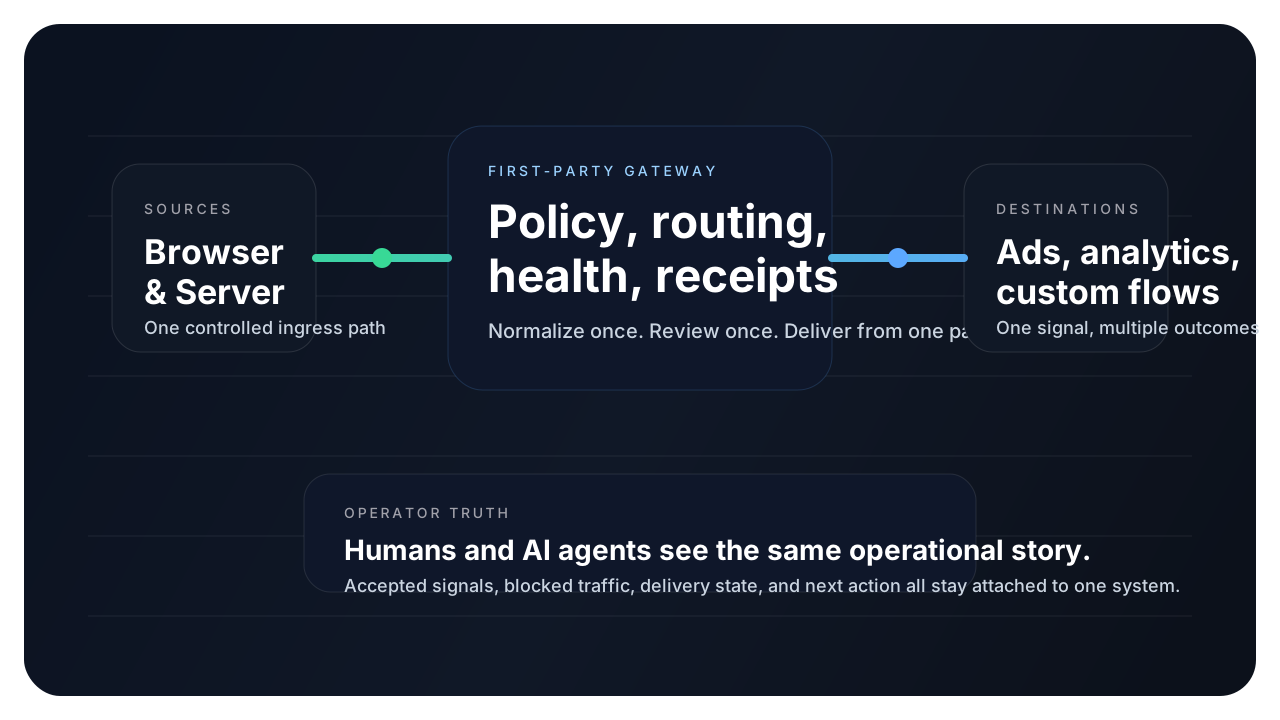
A first-party signal layer is not just collection. It is the controlled path from ingress to delivery, review, and action.
The key idea is not volume. It is control.
When teams say their tracking stack is brittle, they are usually describing one of these problems:
- there are too many collection paths
- each destination has different logic
- blocked or rejected traffic still looks like success until later
- privacy and security rules live in ad hoc notes instead of the actual path
- nobody can answer what happened to a specific purchase, lead, or high-value signal without opening three tools
First-party signal infrastructure exists to remove that ambiguity.
Why teams need it now
The old model assumed the browser could do most of the work. That is no longer a safe assumption.
Modern stacks now have to deal with:
- browser and device restrictions
- blocked client-side scripts
- fragmented destination APIs
- privacy and consent requirements
- teams that need better proof than “the pixel probably fired”
- AI systems that increasingly need structured, current, reviewable product truth
That last point matters more than it first appears. If a human operator or an AI agent is going to diagnose delivery health, explain a missing conversion, or recommend the next fix, the underlying signal path has to be consistent and observable.
That is why first-party signal infrastructure is useful language. It keeps the focus on the whole operating path, not only the transport mechanism.
How it differs from server-side tracking
Server-side tracking is usually one capability inside a bigger operating system.
| Question | Server-side tracking | First-party signal infrastructure |
|---|---|---|
| Primary focus | How signals are delivered | How signals are collected, governed, routed, and reviewed |
| Core promise | Better delivery resilience | One controlled operating path |
| Main success metric | Events reach the destination | Operators can trust, diagnose, and extend the whole signal path |
| Scope | Transport pattern | Ingress, policy, routing, health, logs, receipts, and actionability |
| Best description | Implementation method | Product and operating model |
So if someone asks, “Is first-party signal infrastructure just another phrase for server-side tracking?” the honest answer is no.
Server-side tracking is often how you implement it. It is not the full thing by itself.
If you need the deeper implementation background, read Server-Side Tracking: The Complete Guide after this article.
How it differs from CDPs and tag managers
The confusion usually comes from teams comparing this category to nearby tooling.
| Tool type | Best at | Where it falls short |
|---|---|---|
| Tag managers | Orchestrating browser and GTM-oriented implementations | They are not designed to be the clearest operator-grade source of truth for one governed signal path |
| CDPs | Identity, profile assembly, audience logic | They are broader systems and often heavier than needed when the immediate problem is reliable signal delivery and diagnostics |
| Vendor-native APIs | Sending data to one platform | Each API solves one destination, not the whole operating model |
| First-party signal infrastructure | Running one reliable path for collection, policy, fan-out, and review | It does not replace every downstream analytics or profile workflow |
That distinction matters in evaluations.
If the real requirement is “we need a complete customer-data architecture,” a CDP conversation may be appropriate.
If the real requirement is “we need one reliable way to ingest, validate, route, and review high-value signals,” a dedicated first-party signal layer is usually the cleaner answer.
What a real first-party signal layer includes
A serious implementation should include these building blocks:
1. Controlled ingress
One path for browser or server-originated signals, ideally on a first-party domain you control.
2. Payload normalization
One internal shape for signal names, identifiers, commerce metadata, consent state, and destination-relevant fields.
3. Policy and security
Origin rules, auth checks, redaction, consent handling, and routing controls must live in the path, not only in implementation notes.
4. Destination fan-out
Meta, TikTok, Google, custom webhooks, and other destinations should read from the same normalized path instead of each requiring its own operating model.
5. Health and diagnostics
Logs, blocked traffic, recent failures, and delivery receipts need to be visible where operators can act on them quickly.
6. Human and agent readability
The system should make sense both to the person owning rollout and to the AI workflow explaining what happened.
This is the deeper reason Anacoic uses the language of signals rather than just events. A signal is not only a raw record. It is a unit that has operational meaning, policy context, and a delivery story attached to it.
To see the signal model itself, read Signals Explained.
Where AI agents fit
AI discoverability and agent operations are not the same thing, but they now reinforce each other.
When a business becomes more discoverable to AI systems, those systems still need trustworthy product facts. When an internal agent helps an operator diagnose a gateway, it also needs a consistent control surface.
That is why a first-party signal layer becomes more valuable in an AI-shaped world:
- it gives AI systems structured truth instead of scattered snippets
- it keeps commercial and operational facts closer to the actual system
- it reduces the gap between what the UI says and what the runtime is doing
If you are exploring that side of the stack too, pair this article with:
- How to Make Your Business Discoverable to AI Agents
- What Is MCP? The Model Context Protocol Explained
- AI Agent Gateway
Who should adopt it
First-party signal infrastructure is usually the right move for:
- agencies that want one repeatable client operating model
- technical growth teams who are tired of debugging destination-specific edge cases one by one
- ecommerce teams that need reliable purchase, checkout, and lead signals
- performance-led SaaS companies that want one path for product and marketing conversion signals
- teams preparing for AI-assisted operations and stricter auditability
It is less urgent if:
- your current client-side setup is simple and stable enough
- you only send a small amount of low-stakes tracking data
- nobody on the team needs delivery proof, routing control, or operator-grade health visibility
Implementation checklist
Use this checklist before you claim you have first-party signal infrastructure in place:
- One controlled ingress path exists for your highest-value signals
- Payload naming and identifiers are normalized before delivery
- Security and origin policy are enforced in the signal path
- Destinations read from the same core path instead of separate custom logic
- Operators can inspect recent accepted, blocked, and failed deliveries
- The team can validate one signal end to end without opening multiple disconnected tools
- Documentation explains the system in a way a new operator or AI assistant can follow
If you are not there yet, start with one high-value route first:
- set up a first-party gateway
- validate one signal
- connect one destination
- confirm the delivery health
- expand only after the first path is clean
That rollout approach is much more reliable than trying to migrate everything at once.
FAQ
Is this just a new name for server-side tracking?
No. Server-side tracking is usually one implementation technique inside a broader operating model. First-party signal infrastructure includes the control, routing, policy, and observability layer around that path.
Does this replace a CDP?
Not necessarily. A CDP solves a broader identity and customer-data problem. First-party signal infrastructure solves the narrower but critical problem of running one reliable, diagnosable path for signal collection and delivery.
Does a tag manager still have a role?
Yes. Some teams will continue to use GTM or other tooling at the edges of the stack. The key question is whether your signal truth depends on those tools or whether they sit around a more controlled first-party layer.
Why does this matter for AI agents?
Because AI workflows are only as good as the product truth they can access. A first-party signal layer gives both humans and agents one clearer operating surface for diagnostics, status, and action.
What should I read next?
Start with Signals Explained, then read Server-Side Tracking: The Complete Guide and Stape to Anacoic Migration Guide if you are evaluating rollout options.